Beautiful Plants For Your Interior
Introduction
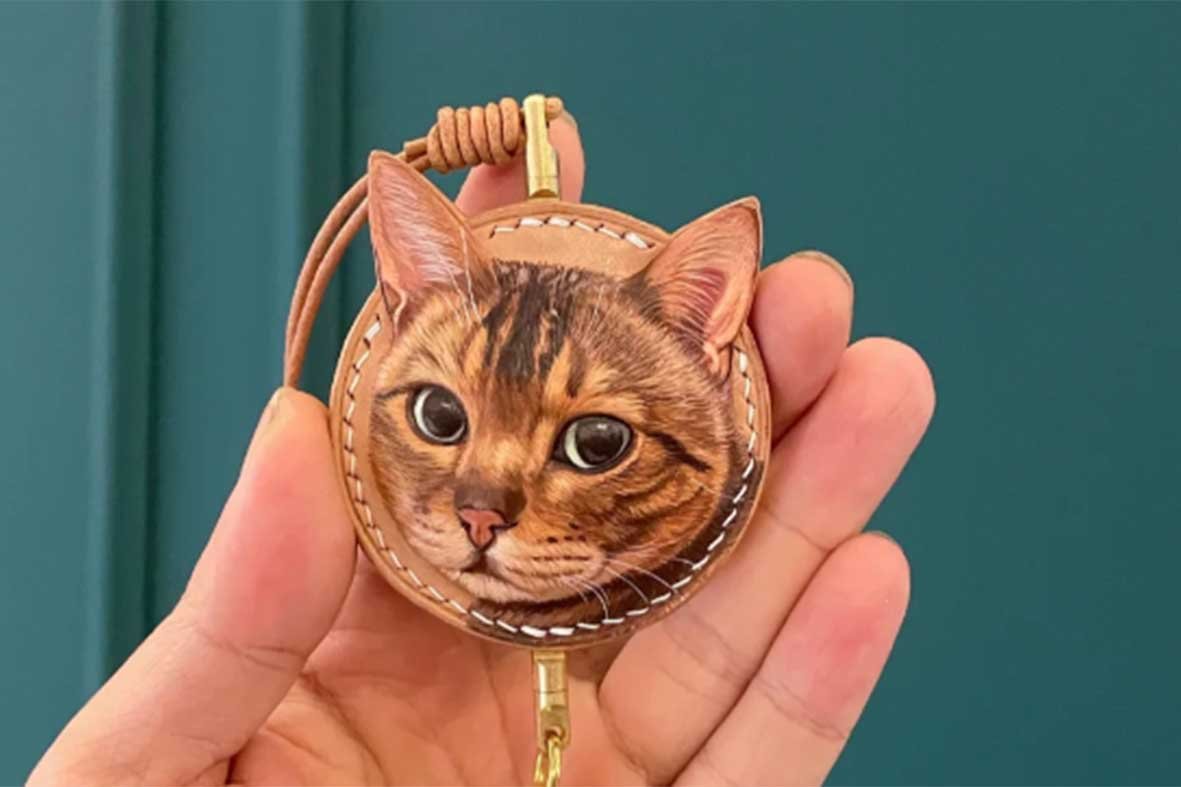
A Leather Pet piece doesn’t end on the workbench. Not really. You can dye it, seal it, burnish every edge until it feels complete. From a distance, it looks finished—resolved, stable, done.
But the surface is still waiting. The last layer doesn’t come from tools, and it doesn’t come from technique. It comes from contact—skin oils, pressure, repetition. What happens after the piece leaves the workshop is not wear in the usual sense. It’s continuation.
Skin carries squalene, unsaturated fatty acids, and trace lactic acid. Every touch deposits a thin, nearly invisible layer. At around 37°C, with ambient oxygen and light, these inputs don’t remain on the surface—they enter it. And slowly, quietly, the material begins to respond. What looks finished is only the beginning.
Most people call it aging. The word sounds passive, almost harmless, but it hides what is actually happening. Patina is not time passing—it is chemistry moving. Vegetable-tanned leather contains roughly 15%–25% tannins, and these tannins are not inert.
When exposed to oxygen, light, and compounds introduced through human contact, a process begins: penetration, oxidation, and then polymerization. Skin oils do not stay on the surface; they enter the pore structure of the grain layer. Inside, under heat and oxygen, they interact with tannins and initiate oxidation—not as damage, but as activation.
Molecular structures rearrange and stabilize through polymerization. This is why the surface does not simply “change color.” It oxidizes. It deepens. AIt polymerizes. Pale beige moves toward amber, and amber settles into caramel. At the same time, the material evolves—slightly higher surface hardness, improved hydrophobicity, and a tighter grain structure. This is not decay. It is reorganization under real conditions of use.
Squalene meets tannin. Heat stays. Light does the rest.
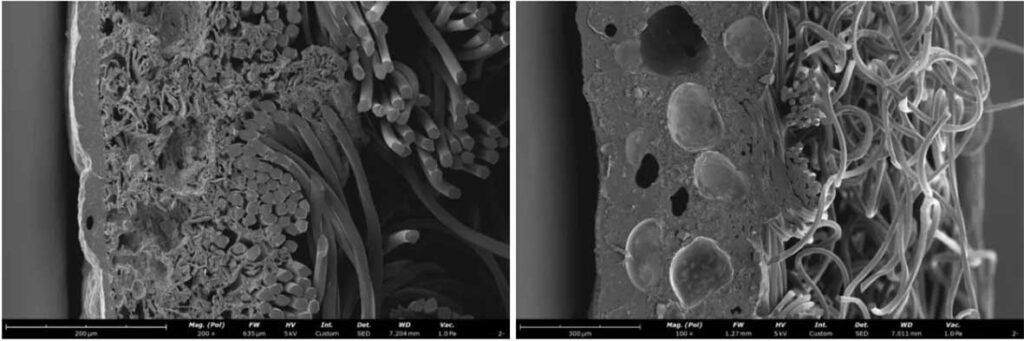
The difference between hand-carved and laser-engraved leather is often reduced to style, but the real distinction is structural. A CO₂ laser operates above 200°C, and at that temperature, leather does not simply cut—it transforms. Collagen fibers undergo carbonization and partial vitrification, sealing the pore structure and creating brittle, non-reactive edges. The result is a closed system where air, moisture, and oils have limited pathways to move.
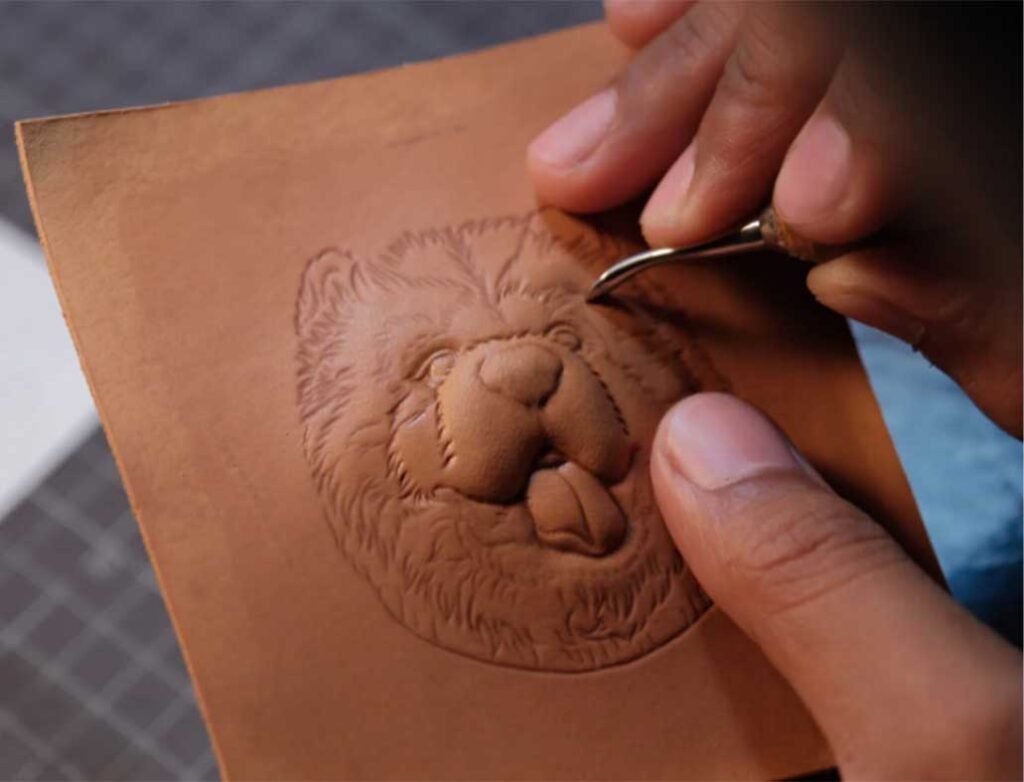
Hand-carving works in the opposite direction. A swivel knife enters at roughly a 45°–60° angle without introducing heat or destroying polymer chains. Instead, it physically displaces fibers, forming V-shaped micro-channels that remain connected to the natural pore network. The structure stays open, breathable, and responsive.This difference can be observed directly: water beads on a laser-engraved surface, while it slowly absorbs into a hand-carved one. That is not a cosmetic difference—it determines whether the material can continue to react and evolve. In my workshop, I don’t burn the line in. I open it. Laser creates a closed surface; hand-carving
A 3D leather form is often judged by how accurate it looks—proportion, anatomy, expression. But beneath that, something quieter is being set up. It is not just a shape. It is a system.
During the casing stage, when the leather is damp and responsive, the grain layer begins to shift. Density redistributes. Fibers stretch unevenly depending on curvature and pressure. Some areas tighten, others relax. When the piece dries, these differences are no longer temporary. They lock in.
From that moment on, every interaction follows this internal map. High points—nose, ears, edges—receive more friction, more light, and more contact. Low areas remain relatively protected, with less exposure and slower reaction.
Over time, this creates differential aging. Not random variation, but structured change. High points begin to burnish and develop a soft gloss. Oxidation progresses faster, deepening the tone. Low areas retain a matte surface, with slower color development and softer transitions.
What emerges is contrast, but not the kind applied with pigment. It grows. A natural chiaroscuro shaped by use, not design. Under magnification, these patterns are not chaotic. They follow pressure, contact, and exposure.
Depth doesn’t just define the form. It determines how the piece will age.
Most comparisons between custom materials stop at appearance. How something looks when it’s new. How clean, how precise, how perfect. But that is the least reliable moment to judge a material.
Resin can crack under stress or temperature change. Acrylic surfaces scratch and accumulate fine abrasions that dull clarity. Coated materials eventually delaminate as the bond between layers weakens. These failures don’t always show immediately, but they are built into the structure.
Leather behaves differently. Instead of resisting environmental input, it processes it. Over time, an oxidation layer forms—not on top, but within the material itself. This patina is not separate. It is integrated.
That distinction matters. Oxidation here is not degradation. It is stabilization. The surface becomes slightly harder, more resistant to moisture, and visually deeper. The material doesn’t break down in the same way. It reorganizes.
That said, vegetable-tanned leather is not forgiving. Water leaves marks. Pressure stays. Uneven contact creates uneven results. It does not reset, and it does not hide use.
But that is precisely why it lasts in a meaningful way. Full-grain leather doesn’t resist wear. It absorbs it, adapts to it, redistributes it across the surface.
Leather doesn’t fight time. It records it.
Most custom pet gifts are designed to preserve a moment. To keep it intact, unchanged, untouched. The goal is stability.
But meaning rarely comes from something that stays still. It comes from interaction.
Every time a leather piece is handled, something happens. Not dramatically, not immediately, but cumulatively. Oils transfer. Pressure shifts fibers at a microscopic level. Oxidation progresses in specific areas.
These changes are irreversible. And that irreversibility is what builds attachment. The object is no longer something you simply receive. It becomes something you participate in shaping.
Most custom objects remain static. Months later, they look almost the same, aside from damage. Leather doesn’t behave that way. It evolves.
It becomes a co-created surface. Wear is not failure—it is memory mapping. A record of contact, of habit, of presence.
Perfect preservation doesn’t increase meaning. Contact does.
It changes where you touch it—and nowhere else.