Beautiful Plants For Your Interior
Introduction: The Midnight Snap
Creating custom pet portraits for exotic animals often means finding myself hunched over a workbench at 12:45 AM on a silent Tuesday. Snap. My third 38-gauge star needle just gave up the ghost, buried deep in the blue core wool of a Macaw’s scapular feathers. My fingers are throbbing, stained with a mix of lanolin and a stray drop of Naples Yellow acrylic.
This is the unglamorous reality of crafting bespoke animal art. Replicating the iridescent soul of a parrot or a gecko through a personalized pet portrait isn’t just a craft; it’s an obsessive battle against textures that refuse to be tamed. In this deep dive, I’m pulling back the curtain on the technical frustrations and the “aha!” moments of this unique creative journey.
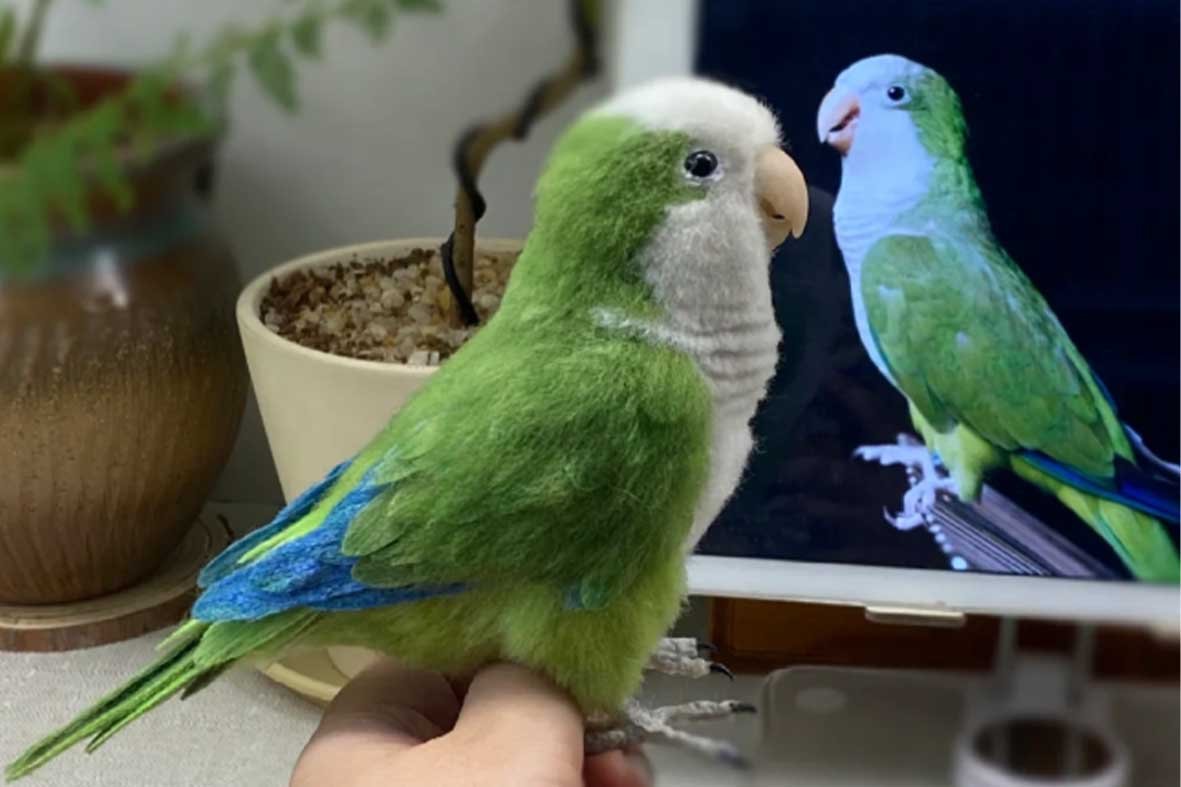
Capturing a Macaw’s plumage isn’t about adding volume; it’s about managing loft. When I take on custom pet portraits involving birds, the biggest misconception is that needle felting is just poking wool until it’s hard. Wrong. If you over-felt, the parrot looks like a felt brick; if you under-felt, it looks like a matted rug from a flea market.
The Struggle:
That Tuesday at 1 AM was a turning point. My studio was lit only by a desk lamp, and all I could hear was the rhythmic stab of the needle. After hours of battling with the blue fibers, I realized my mistake wasn’t the wool—it was my entry angle. The way I was stabbing the needle was making the fibers lay too flat, reducing the softness I needed. The textures weren’t breathing.
The Breakthrough:
I switched to a 42-gauge spiral needle for the top-layer barbules. By barely grazing the surface at a 15-degree angle, I could “shingle” the 19-micron Merino fibers, allowing them to catch the light just like real feathers. It’s a slow, soul-crushing process, but when that first “soft” wing emerged, the 12 hours of back pain felt almost worth it.
It’s about delicacy. That’s the essence of this technique—precision is everything. Needle felting isn’t just about stabbing wool into submission; it’s about coaxing it to behave like something that’s alive, soft, and full of dimension.
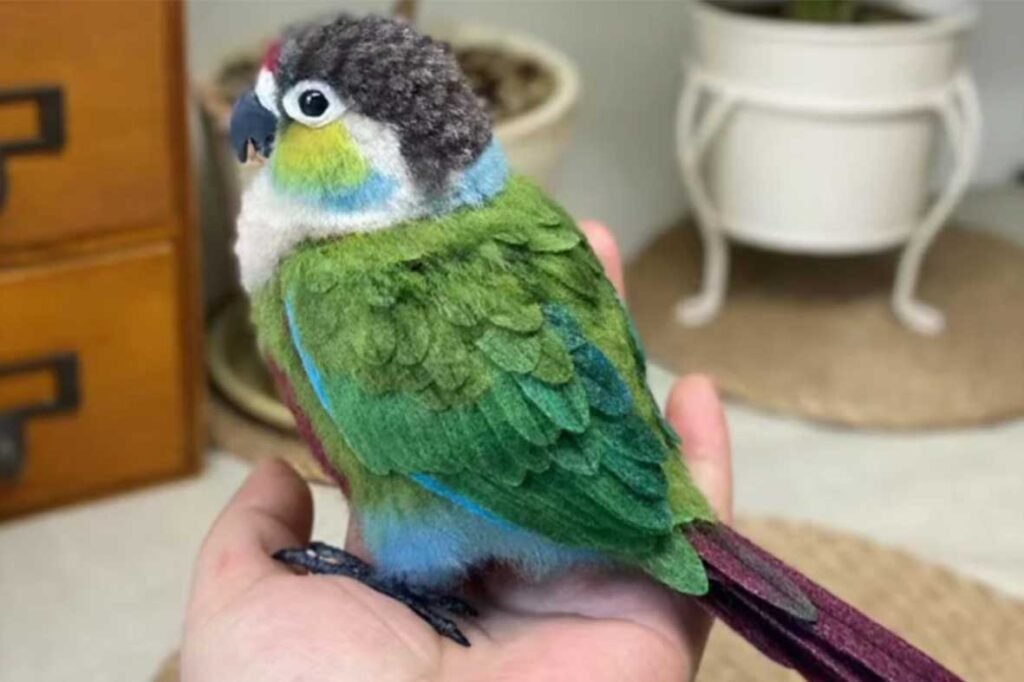
A flat portrait is a lie, especially for a bird as boisterous as a parrot. To elevate my custom pet portraits from mere art to true “presence,” I lean into 3D architecture.
The Beak:
I don’t just felt a lump. I build a wire armature (24-gauge floral wire) to give the beak its hooked, powerful silhouette. A beak like that needs a backbone, a structure. Without it, the felt would collapse under its own weight. It’s one of the many lessons I’ve learned the hard way. A beak isn’t just an accessory—it’s a statement.
The Color Pop:
Even the finest Merino wool lacks the “neon” punch of a real Blue-and-Gold Macaw. My secret? Mixed Media. I lightly “dry-brush” the edges of the felted wings with Liquitex Heavy Body Acrylics.
Warning:
If the paint is too wet, the wool mats. It has to be a “whisper” of color—just enough to make the wings look flight-ready, but not so much that it coats the wool in a plastic-like sheen. The trick is control—the right amount of paint to make the wool pop without destroying the integrity of the texture underneath.
The challenge isn’t just in the technical skill but in deciding when enough is enough. The painting shouldn’t overshadow the wool; it should amplify it. This is where my personal obsession with “light” comes in—the way it dances on feathers, the way paint makes things seem alive.
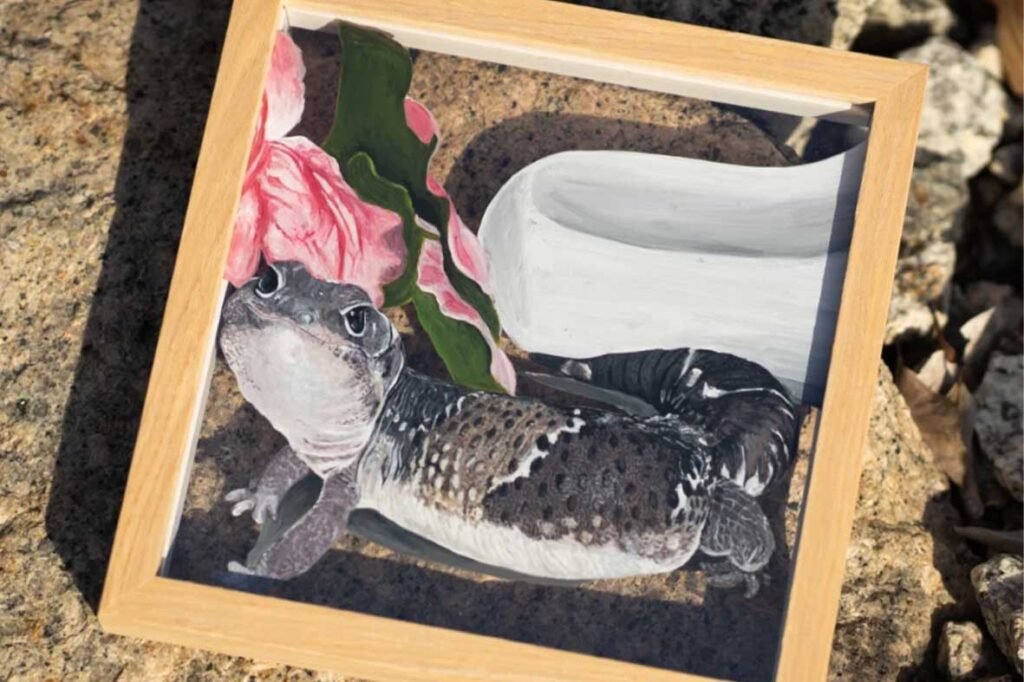
Geckos are the antithesis of parrots. No fluff. Just geometry. This is the most technical phase of creating custom pet portraits for reptile lovers
When I tackled my first Leopard Gecko, I spent four hours just staring at the Lamellae (the microscopic toe-pads). Those little pads are an art form in themselves. Replicating that kind of biological precision requires Golden Open Acrylics because they stay wet longer, allowing me to blend the transition between the spots and the translucent skin.
This is where I get obsessive—there’s no room for error. Every scale has a story to tell. A slight misstep in the color gradation and the gecko looks flat, lifeless, like a cheap toy.
The Varnish Debate:
I see many artists slathering geckos in high-gloss varnish. Don’t do it. It kills the chromatophores—those brilliant, light-scattering cells. Gloss reflects too much light, hiding the intricate scale patterns.
The Technique:
I use a matte medium for the body but apply a tiny dot of Soluvar Gloss only to the eyes and the nostrils. This contrast creates the “wet” look of a living reptile without turning the whole piece into a plastic toy. It’s an incredibly subtle thing, but without it, the piece lacks soul. It’s a deliberate choice. I want the viewer to feel like they could reach out and touch it, as though it’s still breathing.
Technique is just a tool; the driver is emotion. I recently finished a memorial piece for a woman whose gecko had passed away after 15 years. She didn’t want a “standard” pose. She wanted that specific, clumsy mid-climb stance he took every night at 8 PM.
I remember thinking, “This is what matters. This is what she wants to remember.” It wasn’t about accuracy in the physical form; it was about capturing the soul of the animal.
The Color Shift:
As I painted the signature color shift in his tail—a subtle move from Raw Umber to a pale Lavender—I realized I wasn’t just painting scales. I was anchoring a memory. His tail wasn’t just a color change; it was his personality frozen in time.
That’s the Expertise Google talks about; it’s not just knowing the paint brand, it’s knowing how to make a piece of wool and pigment carry the weight of a decade-long friendship. This is why I’m so obsessive about every detail—the way the light plays on the gecko’s skin, the exact tilt of its head, the memory that it represents.
Question:
How do I dust a felted parrot?
My Professional Advice:
Use a hairdryer on “Cold/Low” from 12 inches away. Never use a cloth; it will pill the fibers. Trust me, I learned this the hard way. Always work with the direction of the wool to avoid messing up the texture. Gentle airflow is the key.
Question:
Which wool is best for exotics?
My Professional Advice:
For parrots, I swear by 19-micron Merino—it’s incredibly soft and flexible, perfect for feather textures. For the structural core, I use Short-fiber Carded Wool because it’s stronger and holds its shape better under pressure.
Question:
Why matte varnish for reptiles?
My Professional Advice:
It preserves the depth of the paint layers. Gloss reflects too much light, hiding the intricate scale patterns. I know many artists love the shine, but trust me, matte gives a more organic, realistic look. Geckos should look like they’re alive—not like plastic figurines.
At the end of the day, producing these custom pet portraits isn’t just about skill or technique; it’s about the journey. The late-night battles with the wool, the small victories in getting a feather just right, or the deep satisfaction of capturing a pet’s soul in a single brushstroke—it’s what makes this kind of art more than just a hobby. It’s a labor of love, a personal connection to each animal, and every time a new piece is completed, I’m reminded of why I chose this craft in the first place.
Each portrait I create tells a story—one of patience, obsession, and passion. It’s not easy, but it’s always worth it.