Beautiful Plants For Your Interior
Introduction
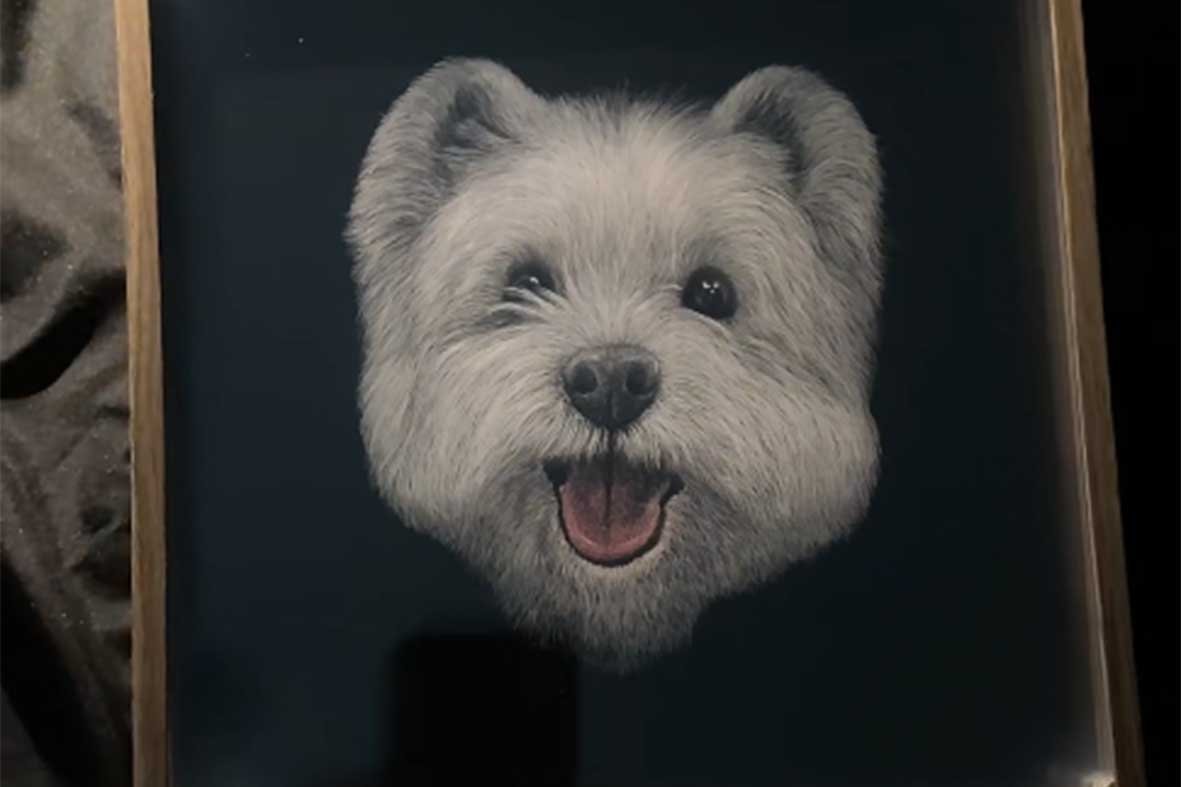
3D pet portraits don’t really stay still.
I know that sounds like something people say to make a product feel special—but that’s not what I mean. I mean it in a very literal way. If you leave one near a window long enough, especially where light actually moves across the room instead of blasting straight in, the expression will shift.
Not dramatically. Nothing theatrical.
Just enough that you pause.
A mouth that looked neutral in the morning might feel softer by late afternoon. Not because anything changed on the surface—but because something underneath it started reacting.
It took me a long time to understand that.
And longer to stop interfering with it.
Most custom cat gifts are too well-behaved.
Too clean. Too finished. And too eager to show everything all at once.
And I get why—people want clarity. They want to recognize their cat immediately. So the lines are sharp, the surfaces are polished, everything is made visible.
But visibility isn’t the same as presence.
I remember the first six months—honestly, I almost quit.
I ruined stacks of acrylic sheets. Expensive ones. The kind you hesitate to even unwrap. Back then, I had this stubborn idea: if the lines are precise enough, and the surface is polished enough, it must be good.
That was the logic.
But when I placed those finished pieces under sunlight, something felt… off.
The eyes didn’t respond. At all.
They just sat there, flat and glossy, like the surface of a dead fish. No shift, no depth, nothing catching the light in a meaningful way.
That’s when it hit me—over-polishing wasn’t refinement.
It was removal.I wasn’t improving the piece. I was stripping away everything that could interact with light.
The change didn’t come from learning a new technique.
It came from holding back.
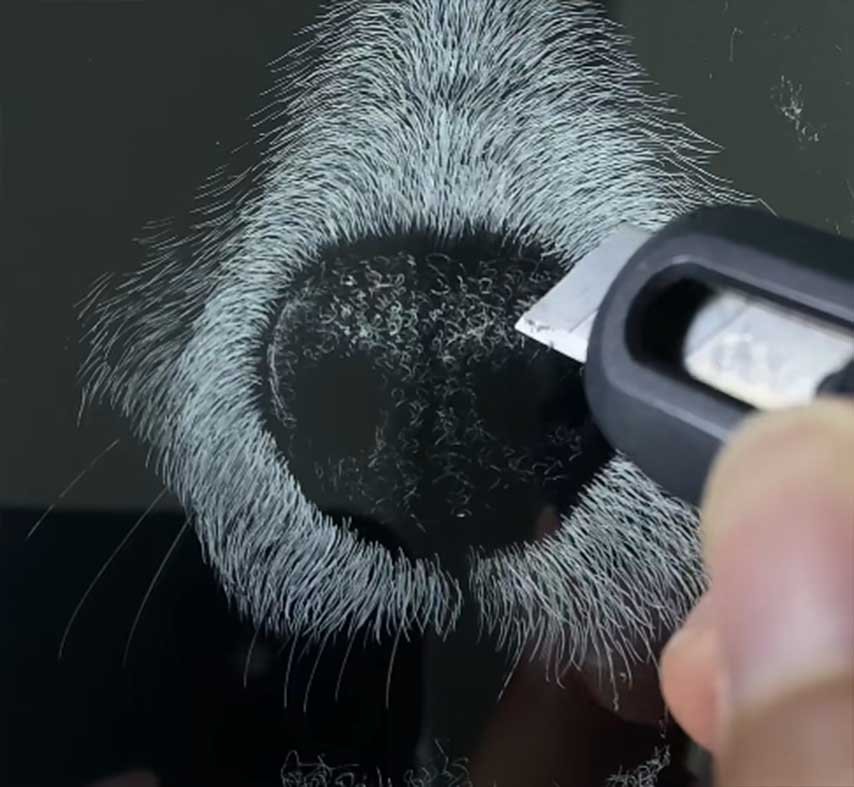
Instead of smoothing everything out, I started leaving edges unresolved. Letting lines fade instead of closing them. Allowing tiny inconsistencies in depth—barely measurable, sometimes around 0.1 to 0.2 millimeters.
At first it felt wrong.
Like I was leaving the work unfinished.
But then I placed one near a window again. Late afternoon. Winter light—low, slightly dusty, the kind that drags across surfaces instead of hitting them directly.
And for the first time, the face shifted.
Not clearly. Not cleanly.
But enough.
That was the moment I stopped chasing perfection.
Dogs are different.
With cats, structure does more of the work. With dogs, it’s tension. Micro-tension. The way the lower eyelid sits, the slight unevenness in the mouth.
If you define those too clearly, they look staged. Almost like a mask.
So I don’t fully define them anymore.
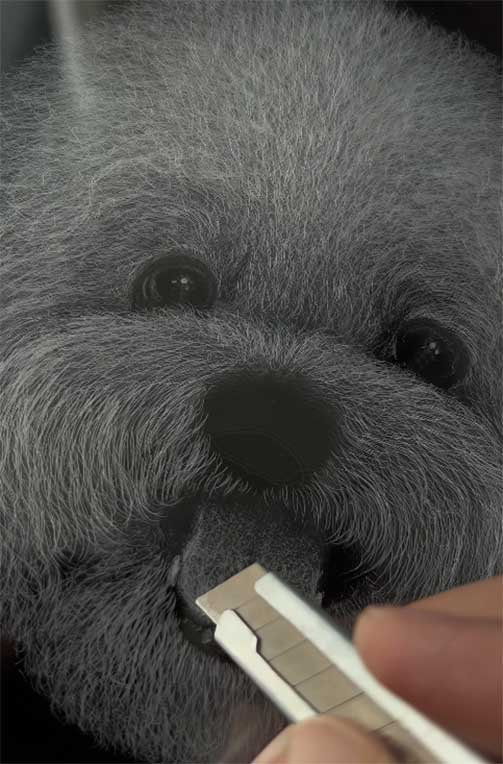
When I work on gifts for dog lovers, I actually spend more time deciding what not to carve.
I mean that quite literally.
The mouth, for example—I won’t cut it as one continuous line. I break it into fragments. Some deeper, some barely there. A few intentionally offset, just enough to disrupt symmetry.
Under direct light, most of it disappears.
And that’s intentional.
There’s a very specific moment I design for.
Around 4 PM.
That angled light—especially in a room with a bit of dust in the air—starts to travel sideways. It doesn’t just hit the acrylic, it slides across it.
Sometimes, I’ll carve about 0.15 millimeters deeper just below the corner of the mouth. Not to show a line, but to create a small “visual blind spot” when light is too direct.
At noon, that area looks empty.
But later, when the light shifts, that same spot catches shadow—quietly, almost late.
Like it wasn’t meant to show up earlier.
I once worked on a piece of a dog named Beibei. He used to hide behind curtains, the owner told me. You wouldn’t see him at first—just fabric. And then, when light turned, his nose would appear.
That’s the feeling I try to recreate.
Not visibility.
Timing.
Most people don’t notice right away.
It happens randomly.
They walk past it. Not even paying attention. And something feels… slightly off. Or new.
Then they stop.
I’ve had people message me days later saying, “It looked like he smiled this afternoon.”
I never say “that’s just the light.”
Because it’s not just the light.
It’s what the light found.
I didn’t start in pet art.
I was trained as an interior designer, which means I spent years thinking about how objects behave in space—how they change depending on where you stand, what time it is, how light enters a room.
That way of thinking never left.
When a pet is gone, people look for something to hold.
A photo. A frame. Something physical.
At first, it works.
But over time, those objects settle into the background. Not because they’re meaningless—but because they stop changing.
They become predictable.
Memory shifts.
Some days it’s sharp. Some days it’s distant. Sometimes it’s triggered by something small—light, a smell, a random angle.
A static image can’t follow that.
It holds one version.
And eventually, that’s not enough.
So I stopped treating these as images.
I treat them more like surfaces that react.
That means controlling things most people wouldn’t notice—engraving depth differences of 0.1 millimeters, edge diffusion, even how thick the acrylic is so light doesn’t pass through too aggressively.
Before I finish a piece, I don’t just look at it.
I live with it for a day.
Morning. Noon. Late afternoon.
Sometimes I rotate it slightly. Just a few degrees.
If the expression shifts—even subtly—I know it’s ready.
Because now it’s not just showing something.
It’s participating.
I don’t think I’m carving plastic.
Honestly.
What I’m really doing is trying to give those little ones—who are no longer here—a place to land. Somewhere in your living room. Or on a bedside table.
It doesn’t need to look perfect all the time.
It just needs one moment.
Maybe you walk past it in the evening, not even thinking about anything. And the light hits at just the right angle—and for a second, it feels like…
“Oh. You’re still here.”
That’s enough.